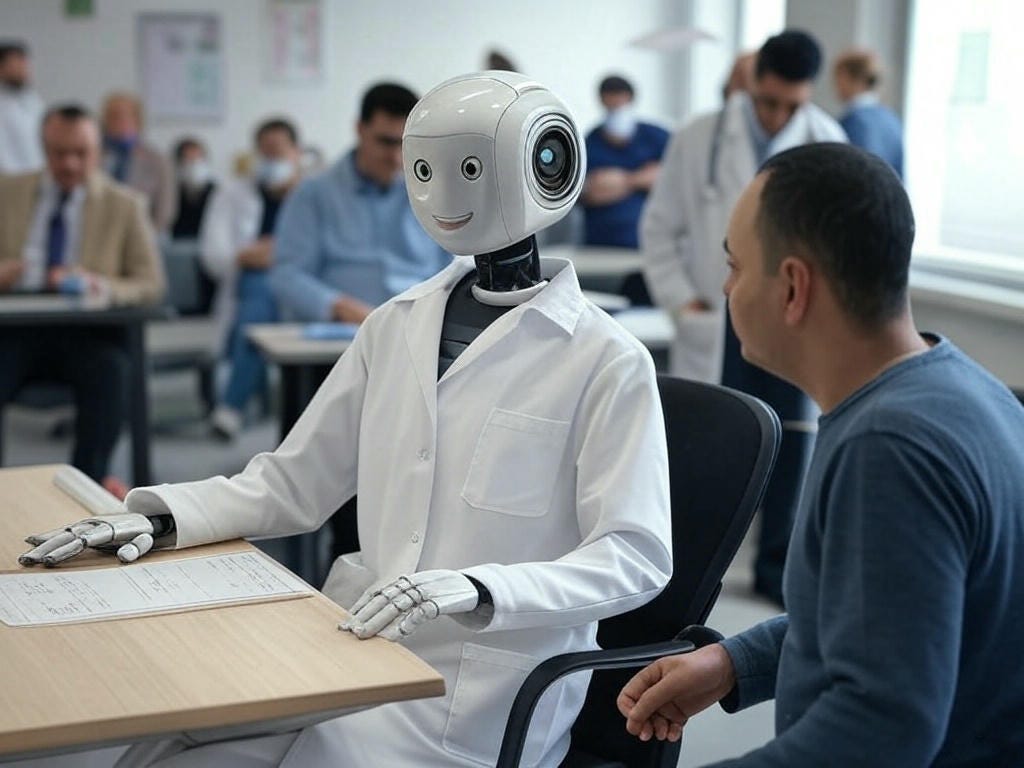
Can AI Change Your Health Forever? Here’s How
AI Can Be A Game-Changer for Navigating Your Healthcare
Leveraging AI for Better Health: A Practical Guide for Patients and Providers
If there’s one thing I’ve learned from practicing medicine beyond the usual playbook, it’s this: healthcare is a chaotic, inefficient maze. Not everywhere, not all the time—but too often, and in all the wrong ways. Doctors are overwhelmed, patients are frustrated, and somewhere in the mix, valuable details—ones that could shape a diagnosis, guide treatment decisions, prevent unnecessary suffering, or even save lives—get lost in the shuffle. Critical conversations get cut short, symptoms get misinterpreted, and essential follow-ups slip through the cracks. What should be a system built for healing often feels more like an obstacle course, where both patients and providers are left navigating blindfolded.
As a board-certified family physician, I’ve spent years watching this dynamic play out. Patients walk into appointments struggling to articulate what’s wrong, often leaving out key details or unsure of what’s relevant. Providers race the clock, juggling an avalanche of documentation, administrative hurdles, and back-to-back appointments. And in between? A system bogged down by inefficiency, fragmented communication, and countless missed chances to provide care that’s tailored, thorough, and truly responsive to each patient’s needs.
This is where artificial intelligence (AI) could step in—not to replace doctors, but to serve as a smart assistant with the potential to enhance how we give and receive healthcare. Think of AI as the friend who reminds you of all the things you meant to say five minutes after your appointment ended. The one who helps you track your symptoms, make sense of your lab results, decode the cryptic abbreviations in your medical records, translate “unremarkable findings” into plain English, or explain why your doctor just described your routine headache with words that sound like an ancient spell. The one who helps you prep for the next time you see your doctor so you don’t leave feeling like you forgot to ask the most important thing. And if you’ve ever walked out of an exam room thinking, Wait, did I actually ask the question I came in for?, you already know how useful that would be.
AI as a Sidekick, Not a Superhero
AI is brilliant at processing information, but let’s be clear: it’s not a doctor. It lacks clinical intuition, it doesn’t know your unique history the way your provider does, and it can’t replace the human judgment that comes from experience—both the experience of being human and understanding what’s left unsaid, and the experience of being a clinician and distinguishing between what’s real, what’s theoretical, and what’s just an idealized version of medicine on paper. What AI can do, though, is help organize your thoughts, break down dense medical jargon, and track health trends that might otherwise slip through the cracks, making it a useful tool—but not a replacement—for personalized care.
That said, AI has some serious quirks, and more often than people realize, it can confidently fabricate information out of thin air or misinterpret the medical relevance of standardized guidelines, sometimes prioritizing rigid protocols over the latest research or real-world patient experiences. It’s designed to be helpful, which sometimes means it tells you what it thinks you want to hear rather than what you actually need—or what would be most useful at a specific stage of an illness. Ever had a friend who hypes you up a little too much, regardless of the situation? That’s AI. It’s why you have to ask it the right questions—not just the ones you think you want answers to, but the ones that push AI to question itself, reexamine its logic, weigh multiple perspectives, and challenge its own conclusions.
That’s where strategy comes in. AI isn’t going to volunteer its blind spots—you have to dig for them. Just like in a real expert roundtable, the loudest voice isn’t always the most insightful, and the most confident opinion isn’t necessarily the most accurate. So, if you’re using AI as a tool in your healthcare journey, you need to be deliberate. Ask it to summarize the strongest evidence, but then follow up by prompting it to poke holes in its own reasoning. Request simple explanations, but also challenge it to cross-check against alternative viewpoints. Encourage it to highlight what’s missing, whether that’s underrepresented perspectives in research or the practical realities that clinical data might overlook. AI can be an incredibly useful assistant—but only if you guide the conversation the right way.
Try This Prompt: “You just gave me information about my condition. Now, can you critique your own response? Where might there be biases, missing perspectives, or alternative explanations?”
Bridging the Gaps in Healthcare
I’ll admit my bias—I study cannabis every day—but if there’s one glaring blind spot in modern medicine, it’s this: cannabis.
Despite its growing acceptance and undeniable medical value, cannabis remains noticeably absent from mainstream healthcare—not because the science isn’t there, but because most doctors never learned about it. The endocannabinoid system (ECS), likely one of the body’s most fundamental communication networks—responsible for maintaining balance and equilibrium across nearly every physiological process—wasn’t even discovered until the 1990s. Yet, despite its significance, medical training, as comprehensive as it should be, largely skips over it. What does that mean for patients? It means their doctors are often operating from outdated, second-hand biases, shaped not by modern research but by generations of prohibition-era thinking. So while the science of cannabis continues to evolve, many healthcare providers are still stuck in a knowledge gap big enough to swallow an entire field of medicine.
This is another place where AI could be a game-changer—not by rewriting medical education overnight, but by making critical knowledge more accessible. With the right prompts, AI can sift through the latest research, analyze patient-reported outcomes, and compile clinical data to help fill the gaps where traditional education has fallen short. It can provide perspectives from both established institutions and emerging research, bridging the disconnect between cutting-edge science and what actually reaches the exam room. If medical schools won’t teach it, and doctors don’t have time to learn it on their own, then AI can at least start the conversation—and for many patients, that’s a long-overdue conversation to have. Whether it’s exploring cannabis as an alternative therapy, understanding how the ECS influences chronic conditions, or even challenging outdated medical assumptions, AI has the potential to empower patients with knowledge their providers may not yet have.
Try This Prompt: “Can you summarize the latest peer-reviewed research on cannabis for chronic pain, and compare it to traditional pain management options?”
Where AI Can Be Most Useful in Healthcare
When used thoughtfully, AI has the potential to make healthcare more efficient, more personalized, and far less frustrating for both patients and providers. Here’s how:
1. Tracking Symptoms Like a Pro
Memory is unreliable, and stress makes it worse. AI can help you log symptoms, track patterns, and make sure you don’t walk into your doctor’s office saying, “Uh, I don’t really remember when it started.”
Try This Prompt:
“Help me create a symptom journal for my recurring headaches. I want to track frequency, intensity, triggers, and any relief strategies that have worked.”
2. Preparing a Structured Medical History
A well-structured history of present illness (HPI) is crucial for accurate diagnosis. Unfortunately, many patients arrive at their appointment struggling to recall key details. AI can help structure this information in a way that mirrors how a clinician gathers data.
Try This Prompt:
“I’m preparing for an appointment with my doctor about ongoing digestive issues. Help me structure my history using the SOCRATES method (Site, Onset, Character, Radiation, Associations, Timing, Exacerbating/Relieving Factors, and Severity) to ensure I provide useful details.”
3. Refining a Differential Diagnosis
While only a trained provider can confirm a diagnosis, AI can help patients explore relevant symptoms and ensure they don’t overlook important details.
Try This Prompt:
“I’ve had fatigue and joint pain for three months. What are some possible conditions that could cause these symptoms? Would knowing about other symptoms be useful to my doctor? What follow-up questions should I ask my doctor?”
4. Generating Questions for Your Doctor
Many patients leave their appointments wishing they had asked more questions. AI can help generate a list of relevant concerns based on their condition and planned treatment.
Try This Prompt:
“I was just diagnosed with high blood pressure. What questions should I ask my doctor about treatment options, lifestyle changes, and medication side effects?”
5. Making Sense of Lab Results
Numbers on a lab report mean nothing unless you know what they should mean. AI can help translate your test results into digestible insights.
Try This Prompt:
“I got my blood test results, but I don’t understand them. Can you summarize key takeaways and let me know which values are outside the normal range?”
6. Navigating Insurance & Medical Bills
Insurance claims and medical billing can feel like a maze designed to make you give up. AI can help patients decode their bills, dispute incorrect charges, and even draft letters to argue for coverage.
Try This Prompt:
“I received a medical bill that seems higher than expected. Can you help me draft a letter to my insurance company to dispute the charges?”
The Future of AI in Healthcare
As AI continues to evolve, its role in healthcare will likely expand in ways we can’t yet fully predict. The potential is enormous: from real-time clinical decision support for providers to AI-assisted robotic surgeries, personalized treatment plans, and even early disease detection through pattern recognition in large data sets. The marriage of AI with wearable technology, genetic profiling, and patient-reported outcomes could usher in a new era of highly personalized medicine.
AI’s potential is enormous, but so are its challenges. One of the biggest concerns is bias—if an AI system is trained primarily on data from certain demographics, its recommendations may be less accurate or even misleading for patients outside that dataset. Then there’s the issue of privacy and security—health data is among the most personal and sensitive information a person has, and without strict safeguards, AI systems risk mishandling or exposing that data. As AI continues to shape the future of healthcare, ensuring that it is both fair and secure isn’t just important—it’s essential.
Regulation is another evolving frontier, where the rapid pace of AI innovation often outstrips the policies designed to govern it. Who takes responsibility if an AI-generated recommendation leads to harm? How do we ensure transparency in how AI makes decisions, especially when even experts struggle to fully explain some of its complex outputs? And how do we strike the right balance between fostering innovation and protecting patients from unintended consequences? These questions aren’t just theoretical—they will define AI’s role in healthcare for years to come, determining whether it becomes a trusted tool or an unregulated risk.
For now, AI is a powerful assistant, not a substitute—a tool that, when used wisely, can enhance healthcare by improving outcomes, reducing inefficiencies, and giving both patients and providers greater clarity, control, and confidence in the medical decision-making process.
AI, Used Wisely, Can Change Healthcare for the Better
Is AI perfect? Nope. Is it going to single-handedly fix healthcare? Not a chance. But can it help patients ask better questions, make sense of confusing medical jargon, and walk into appointments feeling more prepared and less overwhelmed? Absolutely.
When used wisely, AI has the potential to level the playing field—giving patients more control over their health, helping doctors focus on actual care instead of endless paperwork, and making a system that often feels impersonal and frustrating just a little more human. It’s not here to replace your doctor, but it can help you get more out of every interaction with one.
So, go ahead—put it to the test. Ask smart questions, challenge its responses, and use AI as the tool it’s meant to be. The next time you step into a doctor’s office, you won’t just be a patient—you’ll be an informed participant in your own care.
What do you think? Have you tried using AI for your health? Share your experience below!
Think you’ve mastered AI?
Take it up a notch with these expert-level prompts to maximize your health research.
Keep Reading on This Topic…
Unpack More Practical Tools here:
Targeted AI prompts for different medical visits and research challenges.
Discover the world of digital tools from an expert who also happens to be my brother, Jeremy Caplan:


For those who want more of digital technology, discover a Substack full of the world of digital tools from an expert who also happens to be my brother, Jeremy Caplan:
https://wondertools.substack.com/p/surprising-ways-to-prompt-ai